3. Robin Evans in a text for
the Architectural Association in 1997 commented that when a congenitally
blind person sees for the first time, the succession of spaces is no longer
a horizontal continuity, in the sense of an extension of a succession of
events, according to the horizontal sense of movement. When this person
first saw, he was dismayed when he realised that space continued above,
dizzyingly beyond his reach. In the project the creation of places is based
on a complete understanding of space and the influence of its different
escapes. The vertical component of this interior space is reflected in the
domes and its escapes through the skylights. When we are in the exterior,
the evidence of the vertical component is intensified by contrast; there
is no roof and the sides are almost incorporeal. The material in itself
does not limit the lateral views. However when there are two walls, their
plays of reflection and reflections limit the lateral views. A new landscape
or the extension of the surrounding landscape is contemplated in the interior
of the project.
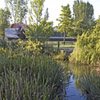
The crosses create intersections and these are read by the visitor by means
of routes. All the routes are around the two courtyards which represent
artificiality through the Japanese garden which is elevated at the level
of the pavement of the rest of the Centre. It reminds the visitor of its
artificial existence as it is separated from the land, and nature with the
presence of a second riverbank garden which grows in direct contact with
the land.
The tour of the Centre begins with a projection room where the visitor receives
his first immersion in information. The tour is always double or infinite,
as there are no doors between the different spaces, and allows both the
visitor and the organizer of the Centre to establish infinite routes depending
on exhibition needs or the interests of the visitor.
The building is wrapped up in itself to create an abstract idea of the surroundings.
The whole project endeavours to make the most symbolic points of the program
clear constantly.
The exit after the tour is along a roofless corridor with glass walls. This
is the only time one loses the direct views of the courtyards although their
presence is still felt. The two glass walls and the absence of a roof attempt
to give the visitor the feeling of going along inside a river. The exit,
like the arrival, is along a walkway over a garden with native plants.
THE VERTICAL COMPONENT
CENTRE FOR THE INTERPRETATION OF RIVERS, Interreg. Órbigo,Tera, Esla,
Spain
The project is carried out on three levels: in relation to the place, responding
to the program and developing the perception of the space. The levels mix
and converse and the project emerges from where they cross.
1. In its relationship with the place where it is introduced, the design is
outlined following premises such as minimal impact on the surrounding nature
and therefore intervening in a semi-natural environment with criteria of passive
sustainability (the attitude which we believe is the most efficient and active
with regard to the surroundings), with a cultural program and using materials
whose ageing process allows the building to converse with the changes in tone,
colour and light of the surroundings. All this is done without renouncing
the carrying out of an abstract work (not imitative of the context) involving
a man-made intervention, a violent work in the sense that Ignasi de Sola Morales
expressed, “…architecture is an act of violence, because it changes
the nature of the materials it uses and the place where it is situated”,
it transforms them, it models them and therefore is violent towards the space
on creating something new which did not exist previously. A violence understood
as the change which occurs in living beings when they grow, walk and live.
2. Programmatically the project
is outlined as the grouping of five modules around a courtyard on two levels.
The whole, presented as a single architectural element, develops its five
thematic areas as a single room, its routes embracing the two courtyards,
which represent two opposites, artificiality and nature, as counterpoints
on which life the creation of life is based. Life is represented and interpreted
here by the river, the element which waters the terrain in accordance with
its natural-geographical conditions but also as a creating process of life
through the artificiality imposed by man.
Its condition of a flood plain, situated in a fluvial valley defines the solution
proposed from its beginnings. Therefore the building is elevated above the
natural terrain by means of a system of piers. Access is gained by means of
a ramp, which serves for penetration but also as an element which, on being
elevated from the terrain, permits its observation, emulating the feeling
of being removed for the land which any river gives us when we try to cross
it or navigate it.
TECHNICAL
DATA, more
Architect:- José Juan Barba (project and management of the works).
Collaborating Architect.- Concha Llorden (project). Collaborators.- Andrés
Ferrero, Alex Puigborn, Pablo Cruz (infography), Juan Carlos Yusto (model),
Menelaos Yorgos, Ramón Barreiro (structures), Miguel A.Vecino (quantity
surveyor), Daniel Juan (quantity surveyor) Rosa Pérez Fdez. (engineer.)
External Collaborators: J.M. Aller (interior models), Illione (furnishing),
Alberto de Prado, Hess-Iluminación (lighting), Agustín Maestro
Garnilla (installation of air conditioning), Ferroblan S.L. (concrete), Luis
Aragoneses (PERI).
Construction Company.- Villar y Vara, Ferroblan (structure of vertical concrete
and ramp), Manuel Rubial S.L. (stainless steel), Terraconti (floors), Asprosub
(garden).
Developer.- Interreg Projects, European Union. Spain/Portugal.
Photography.- Ignacio Bisbal Grandal.